Kaiser Ultimate Health Builder
Whatever Tomorrow Brings. Kaiser is designed as long-term healthcare preparation with life-protection and accumulated-value features. It prepares for more than one possible future instead of assuming we know which one will happen.

Three things can happen to us.
The planning question is not which one will happen. It is whether your financial plan can cope with each possibility.
 What if I die too soon?
Protect the family
Life insurance can provide immediate financial support for people who depend on your income—for living costs, education, debts and other obligations.
What if I get sick?Prepare for healthcare
Healthcare costs can arise while you are working and later in life. The bigger long-term question is what healthcare resources remain after employment or current HMO coverage ends.
What if I live a long life?Prepare for later years
A longer life can mean many years of retirement and healthcare needs. Unused benefits and accumulated long-term healthcare value are intended to help address that later-life need.
How Kaiser works
K-100 has three distinct periods. The seven-year paying period is not the same as the full benefit period.
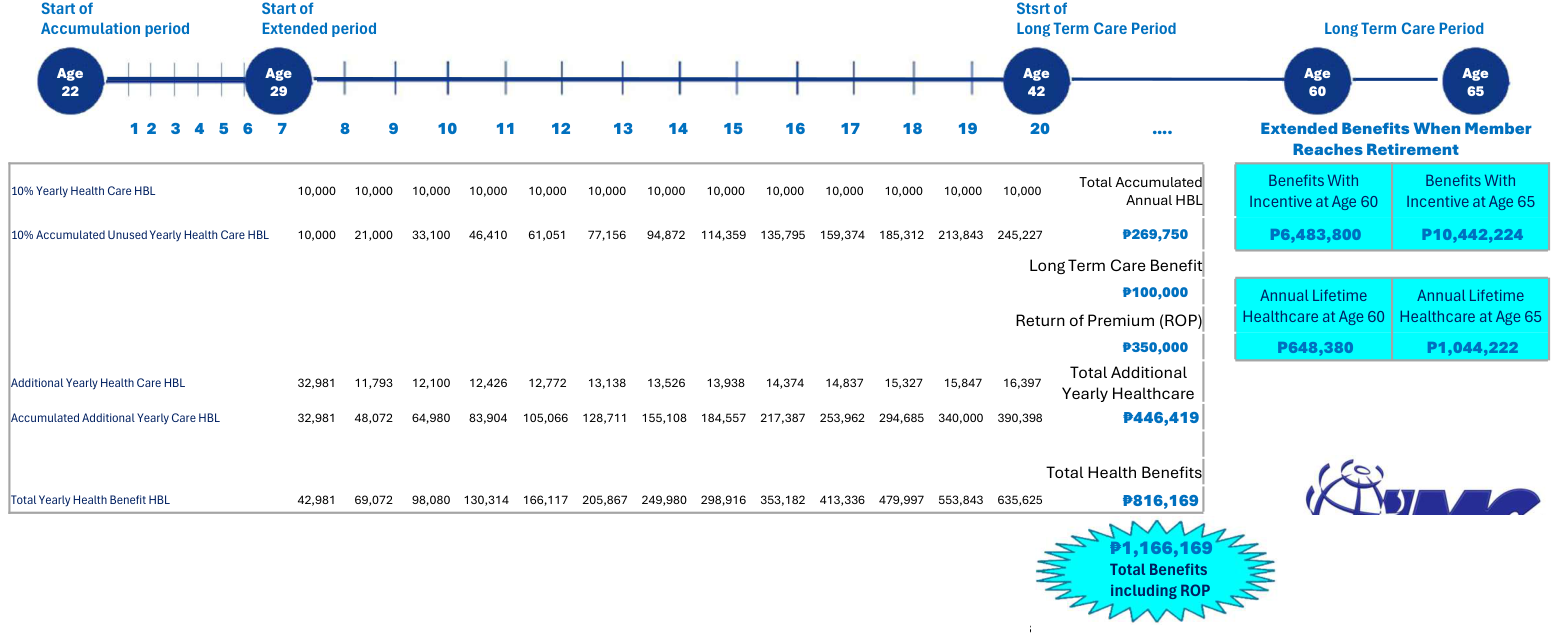
Accumulation / paying period
Membership fees are paid. Benefits include APE, dental, basic medical benefits, room & board and an annual benefit limit, plus waiver features and life/AD&D protection, subject to plan terms.
Extended period
Payments have ended in the seven-pay structure. Benefits continue and unused yearly healthcare HBL accumulates. Room choice/budget in this period is charged to the available Yearly Health Care HBL.
Long-term care period
The plan moves into its long-term-care stage. Accumulated healthcare value and post-maturity options become the central part of the plan.
What is included in K-100?
Healthcare benefits
- Annual Physical Examination
- Dental benefits
- Basic medical benefits
- ₱1,000/day room & board during accumulation
- ₱60,000 annual benefit limit in the K-100 illustration
Protection features
- Term-life accumulation through the 20th year
- Accidental Death & Dismemberment through the 20th year
- Waiver of membership fees due to death
- Waiver due to total and permanent disability
Long-term value
- Unused Yearly Health Care HBL can accumulate
- The actual HBL increment varies with prevailing market rates, with a stated floor of 3% p.a.
- Long Term Care Benefit Value and experience-incentive HBL at maturity, subject to conditions
K-100 illustration at a glance
These K-100 figures are an illustration, not an individual quotation.
| Annual modal membership fee | ₱58,821.43 | Total membership fee | ₱411,750 |
|---|---|---|---|
| Annual benefit limit | ₱60,000 | Room & board | ₱1,000/day during accumulation |
| Long Term Care Benefit Value | ₱100,000 | Long Term Care Experience Incentive HBL | ₱350,000 |
| Combined LTC amounts shown | ₱450,000 | Illustrated accumulated healthcare experience incentive + HBL | ₱1,166,169 |
Why start early?
A 10% compounded-growth example with no healthcare claims demonstrates the effect of time. It is an illustration, not a promised return.
Limited-pay preparation
Fund long-term healthcare while young, healthy and earning instead of waiting until retirement to address the need.
Use now vs. preserve for later
The plan can provide healthcare benefits before maturity, but using benefits can reduce what remains to accumulate. That creates a real planning trade-off between present use and future value.
Healthcare after employment
Employer-based short-term healthcare may end when employment ends. Kaiser is designed to prepare for long-term healthcare beyond that coverage.
Year 20 is not necessarily the finish line.
At maturity, a member may keep part of the accumulated value in the plan and retain healthcare-related access, or withdraw the full amount and end those continuing benefits. Available options depend on the contract.
The practical idea
If the accumulated healthcare fund is not needed immediately at maturity, leaving value in the long-term-care structure may allow it to continue serving the healthcare purpose for which it was built. A full withdrawal changes that relationship.
Who may want to explore Kaiser?
Working adults
Especially people with many years before retirement who want to prepare before employer healthcare ends.
Breadwinners and families
People who value healthcare preparation together with life-protection features during the covered period.
Professionals, entrepreneurs and OFWs
People building their own long-term healthcare fund rather than relying only on an employer benefit.
Frequently asked questions
Do I pay for 20 years?
No. The illustration uses a seven-year paying/accumulation period. The extended and long-term-care periods are different from the paying period.
Does the life insurance end after seven years?
No. Term-life coverage continues through the 20th year, subject to plan terms.
What happens if I use healthcare benefits?
Healthcare benefits are there to be used when needed, but use can reduce later accumulated value. The effect depends on when and how benefits are used.
Is the illustrated growth guaranteed?
No. The 10% example is illustrative. The actual Yearly Health Care HBL increment may vary with prevailing market rates, with a stated minimum of 3% p.a. for that component.
What happens after Year 20?
The plan enters its long-term-care stage. Accumulated healthcare value and applicable post-maturity options become central. Confirm the available settlement options from the contract.
Download “The 3 What Ifs” short brochure.

Start with the healthcare need—not the product.
Explore your current coverage, retirement horizon and long-term healthcare gap first.